8. refer to figure 2. what is the consumer surplus if the price is $150?
Consumer Surplus is defined every bit the difference between the amount of money consumers are willing and able to pay for a expert or service (i.e. willingness to pay) and the amount they actually end up paying (i.east. the marketplace cost). Every consumer has an individual willingness to pay for a specific product. Thus, if the market place toll is above that amount, they volition not buy that item good or service. However, every bit long every bit the market price is below or equal to their private willingness to pay, they will purchase the production to satisfy their needs.
Then how can we summate consumer surplus, given its individual nature? Well, that's really not as complicated as it may sound. In fact, calculating consumer surplus follows a simple 4-step process: (i) depict the supply and demand curves, (2) find the market cost, (three) connect the toll axis and the market price, and (4) calculate the area of the upper triangle.
one) Describe the Supply and Demand Curves
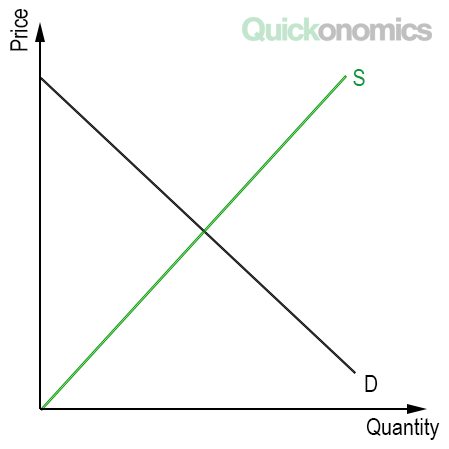
The easiest way to calculate consumer surplus is with the assist of a supply and need diagram. The diagram above has quantity on the x-centrality and price (in USD) on the y-axis. Please notation that it is critical to understand the relationship between supply and need beginning in order to fully comprehend the concept of consumer surplus. And then if you lot are not familiar with supply and demand nonetheless, brand sure to read our article on the police force of supply and demand kickoff.
In one case again, nosotros will use a unproblematic example to walk through the process. Let's expect at an imaginary burger restaurant called Super Burger. If we want to depict the supply and demand diagram for this eatery, nosotros demand to know the corresponding functions get-go. You can learn how to calculate linear demand functions in a different post. For at present, let's just say the demand function is QD = -166.7x + m, and the supply function is QS=166.7x. Note that we are using linear functions (y = ax + b) for the sake of simplicity. Nevertheless, be aware that not all supply and demand functions are linear. Nosotros can now use the two functions to draw the supply and demand curves.
2) Find the Market Price
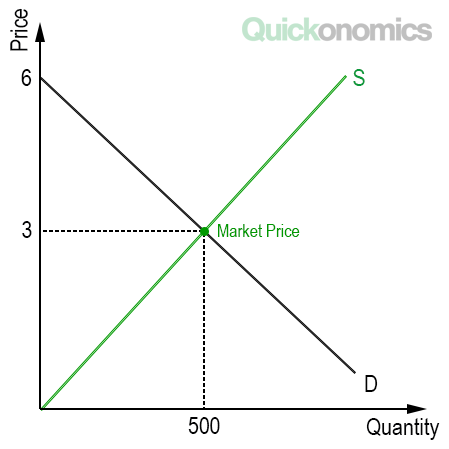
Now that nosotros have drawn the supply and demand curves, nosotros can locate the market cost (i.e. the equilibrium price). As we know (co-ordinate to the law of supply and demand), the market price is located at the intersection of the supply and the need curve (i.e. supply function = need role). Thus, to calculate the market cost we first demand to solve this equation for the equilibrium quantity. Then nosotros tin can find the corresponding price by plugging the effect back into the supply (or demand) function.
In our example, the equilibrium quantity tin be calculated every bit -166.7x + thousand = 166.7x. If we solve this equation for ten, we find that x=three.00 USD. That means, in the market place equilibrium, Super Burger can sell its burgers at a cost of 3.00 USD. If we plug this back into the supply part (QSouth=166.7*3) we notice that the equilibrium quantity is 500 burgers. In other words, Super Burger can sell a total of 500 burgers at a market place price of USD iii.00 per burger.
3) Connect the Cost Centrality and the Market Cost
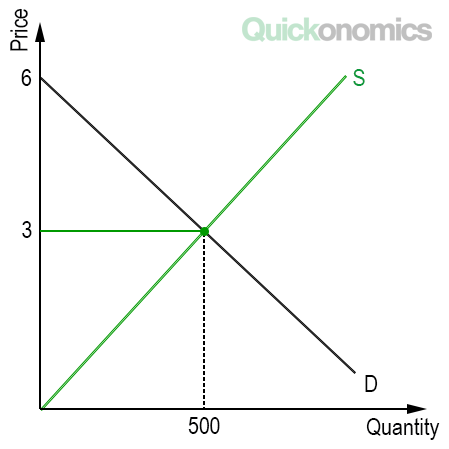
Now that we take calculated the market place price and quantity, we tin can take another await at the supply and need diagram. Equally you tin can run into, the market cost is usually not the highest possible price at which the product could be sold. That ways, in that location are commonly at to the lowest degree consumers who would have been willing to buy the good or service at a higher price than the actual marketplace price. These consumers now enjoy a consumer surplus of their private willingness to pay minus the market place toll. To illustrate this, we tin draw a horizontal line between the y-axis and the market equilibrium (i.due east. the intersection of the supply (S) and demand curve (D)).
In our case, this line intersects the y-centrality at USD iii.00. This creates two triangles, 1 higher up the USD three.00 line and another one below the line. The surface area of the upper triangle represents the sum of all individual consumer surpluses, which is equal to the total consumer surplus. We will look at how to calculate it in the next step.
iv) Calculate the Surface area of the Upper Triangle
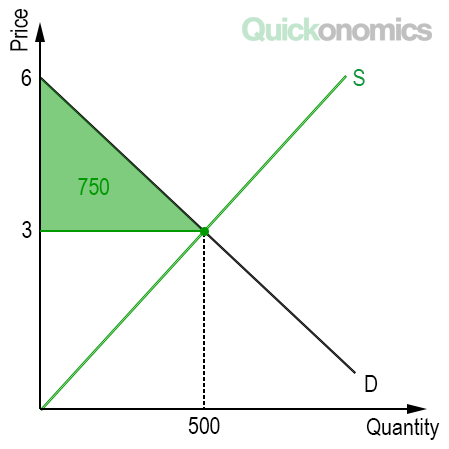
To calculate the surface area of the upper triangle, we can multiply its base of operations with the height and and so divide the result by two (surface area = [b*h]/two). This holds true as long as the demand curve is linear. If that's not the example we have to use a more complex formula to calculate the surface area under the curve (note: Wolfram|Alpha has a useful widget to help you lot with that).
Going back to our instance, nosotros can calculate the area of the upper triangle as follows: The base of the triangle is 500 and the height is three.00. If nosotros plug this into the formula we go (500*3)/2 = 750.00. That ways the total consumer surplus is USD 750.00.
In a Nutshell
Consumer Surplus is defined as the difference between the corporeality of money consumers are willing and able to pay for a expert or service (i.e. willingness to pay) and the corporeality they actually stop up paying (i.e. the market price. To calculate consumer surplus we can follow a simple 4-step process: (1) describe the supply and demand curves, (ii) find the market price, (3) connect the price axis and the market price, and (4) calculate the expanse of the upper triangle.
Source: https://quickonomics.com/calculate-consumer-surplus/

Publicar un comentario for "8. refer to figure 2. what is the consumer surplus if the price is $150?"